

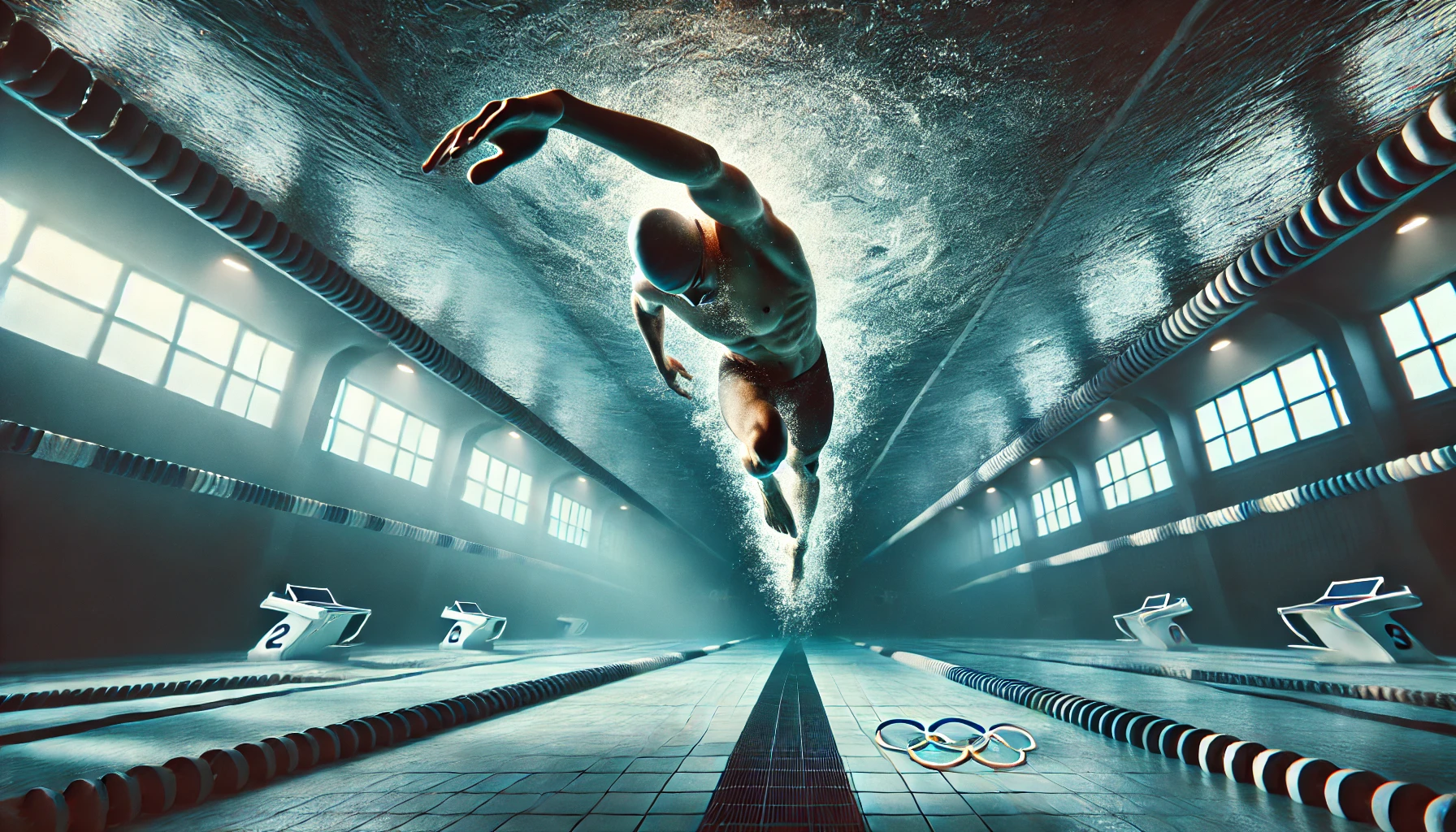
Sprint freestyle is ruthless in the best way. You can do everything right for most of a race, then lose it in the smallest slice of time. The paper you linked keeps showing up in conversations for one simple reason. It treats that razor thin margin as a design problem, not a mystery. It gathers strength, resistance, core, and plyometric training studies and asks a brutally practical question. What actually moves the stopwatch and what shifts the mechanics that drive it.1
Chasing the Blink
Kwok and colleagues pulled together longitudinal interventions and judged them on outcomes swimmers care about. Sprint time, stroke rate, stroke length, force, strength, plus the race moments that feel like their own disciplines, the start and the turn.1
Across the set of included studies, the message is consistent enough to matter. Adding strength and conditioning alongside swim training tends to improve sprint freestyle performance, and the meta analysis supports improvements in fifty meter and one hundred meter outcomes compared with swim training alone.1
The most performance relevant detail is not just that times improved. It is how the improvement appears to show up in the water. Stroke rate demonstrates a reliable positive change overall, with resistance based approaches standing out the most in the quantitative synthesis.1 Stroke length is trickier. The pooled results for stroke length are not clearly favorable and are more inconsistent across studies, which is exactly what you would expect when different athletes, training doses, and measurement methods collide.1
Starts are where the paper gets especially tangible. Plyometric training tends to help the launch and early meters, but the review also flags that evidence is not yet strong enough to confidently promise turn improvements or overall swim improvements purely from plyometrics, at least given the limited and varied literature it found.1 That honesty is part of why the work lands. It separates what is likely to pay off from what still needs measurement and patience.
Proof in the Splash
Reading one study can feel like reading one brushstroke. This is more like stepping back from the canvas. When you line Kwok’s findings up with other peer reviewed syntheses and trials, four benefits become clear. Some are confirming, some are corrective, and both kinds are useful.
A clearer case for dry land as a sprint enhancer
Kwok’s synthesis supports meaningful improvements in freestyle sprint performance when strength and conditioning is added alongside swimming, not instead of it.1 A newer systematic review and meta analysis focused on resistance training methodology similarly reports improved freestyle performance across multiple short to middle distances and stronger upper limb strength in competitive swimmers.2 When two separate meta analyses point in the same direction, you gain something simple and powerful. Permission to invest effort in dry land work without feeling like you are betraying the pool.
Stroke rate becomes the dial you can train on purpose
Kwok’s meta analysis finds a significant overall improvement in stroke rate, with resistance training showing the strongest effect among the training types they separated.1 Jin and colleagues reinforce that theme and go further by arguing that performance gains from resistance training may be driven more by increases in stroke rate than by increases in stroke length.2 That aligns with Crowley and colleagues’ systematic review, which discusses how different resistance training approaches may transfer differently to technical parameters, including stroke rate and stroke length.3 The benefit here is not just faster swimming. It is improved steering. You can treat stroke rate as a skill influenced by strength and specificity, then validate it with simple pool metrics instead of guessing.
Starts respond well to elastic power work
Kwok’s review concludes that plyometric training tends to improve start performance and early phase kinematics and kinetics.1 A randomized controlled trial in adolescent swimmers found that adding plyometrics to habitual training produced greater improvements in start performance outcomes such as time to the early meters and take off velocity compared with habitual training alone.4 This is a gift for sprint swimmers because the start is a moment you can practice with clarity. It rewards intent, timing, and power in a way that feels almost mechanical.
Core training acts like a bridge and the mixed evidence is still useful
Kwok’s review notes that core training can support sprint performance enhancement, and it offers a plausible mechanism, improved trunk stability and coordination that helps the kinetic chain transfer force into cleaner propulsion.1 A focused intervention study on national level swimmers reported improvements in fifty meter freestyle performance alongside improvements in specific race elements including turn related measures in the experimental group receiving core training.5 More broadly, a systematic review and meta analysis on core stability training in youth swimmers reports a moderate statistically significant improvement in swimming performance overall, with stronger effects in short distance events and dose considerations that matter for planning.6
Here is the constructive tension. Kwok’s pooled results do not show clear favorable changes for stroke length overall and do not show core training as a reliable driver of stroke rate in the meta analysis slices.1 Jin’s meta analysis likewise points out that stroke length often does not significantly improve with resistance training in aggregate, even when performance does.2 That contradiction is a benefit because it protects you from a common trap. Chasing a bigger stroke at all costs. The science suggests a better framing. Use core and strength work to support a stable platform and better force production, then let the water decide whether the result shows up as a longer stroke, a quicker stroke, or a smarter blend. Measure it, do not assume it.
Talk Your Way to Faster Water
Evidence is universal. Bodies are personal. Your event, your limb lengths, your injury history, your schedule, your equipment access, and your current technique all change what the best version of strength and conditioning looks like for you. This is where conversational AI can raise engagement, not by replacing coaching, but by helping you ask better questions and run cleaner iterations.
- The coach who also doubts you
Act as my sprint freestyle strength coach and skeptical sports scientist. Ask me about my primary events, training week structure, access to equipment, injury history, and recent race or time trial data. Then design a strength and conditioning plan that fits my week and explain how each session should translate to changes in stroke rate, stroke length, start quality, and turn exit speed. End by giving me a simple checklist to evaluate whether the plan is working after each week. - The start lab in plain language
I want to improve my start. Ask me what start style I use, what my biggest weakness feels like, and what constraints I have for land based training. Then give me a technical checklist for the block, flight, entry, and underwater phase. Recommend a small plyometric progression and a matching pool drill progression that emphasize safety, consistency, and measurable improvement. - The data designer for swimmers
Help me build a one month training experiment based on research about strength and conditioning for freestyle. I want to change one variable at a time. Ask me what I can measure consistently, video, stroke count, tempo, perceived effort, or wearable data. Then propose a baseline test, a weekly test, and a decision rule for whether to keep the change. - The creative routine builder
Build me a sustainable routine that connects performance with lifestyle. Ask me about my schedule, stress level, sleep, and what creative practices I enjoy. Then propose a daily micro ritual that blends art, science, technology, and design so I can stay consistent without burning out. Include a way to reflect, a way to measure, and a way to recover.
Build a Practice You Can Keep
Performance that fits the person, not just the plan
A sustainable loop is not about doing more. It is about designing repetition you can live with, then letting feedback shape the next pass. The paper gives you the science lens, but you still need the artist’s eye, the technologist’s tools, and the designer’s discipline to make it real in your own life.1
- Treat training like a studio practice and keep a tiny daily log that includes one felt sensation from the water, one objective data point, and one quick sketch or metaphor that captures your best rep
- Create a transfer ritual that links dry land to the next swim session by pairing each strength focus with one simple water drill that expresses the same force direction and body line
- Use technology as a gentle guardrail rather than a judge by setting reminders for warm up, mobility, and sleep, then designing your environment so the easiest choice is the one that supports recovery and consistency
References
Kwok W Y, So B C L, Psycharakis S, Ng S S M. A systematic review and meta analysis biomechanical evaluation of the effectiveness of strength and conditioning training programs on freestyle swimming performance. Journal of Sports Science and Medicine. 1
Jin G, Jin Y, Zhang H, Fu X, Yang Y, Lin S C. The methodology of resistance training is crucial for improving short medium distance freestyle performance in competitive swimmers a systematic review and meta analysis. Frontiers in Physiology. 2
Crowley E, Harrison A J, Lyons M. The impact of resistance training on swimming performance a systematic review. Sports Medicine. 3
Bishop D C, Smith R J, Smith M F, Rigby H E. Effect of plyometric training on swimming block start performance in adolescents. Journal of Strength and Conditioning Research. 4
Karpiński J, Rejdych W, Brzozowska D, Gołaś A, Sadowski W, Swinarew A S, Gupta S, Stanula A. The effects of a six week core exercises on swimming performance of national level swimmers. PLOS ONE. 5
Liu S, and colleagues. The effects of core stability training on swimming performance in youth swimmers a systematic review and meta analysis. 6